Transcript: AMA President Dr Danielle McMullen, National Press Club of Australia address
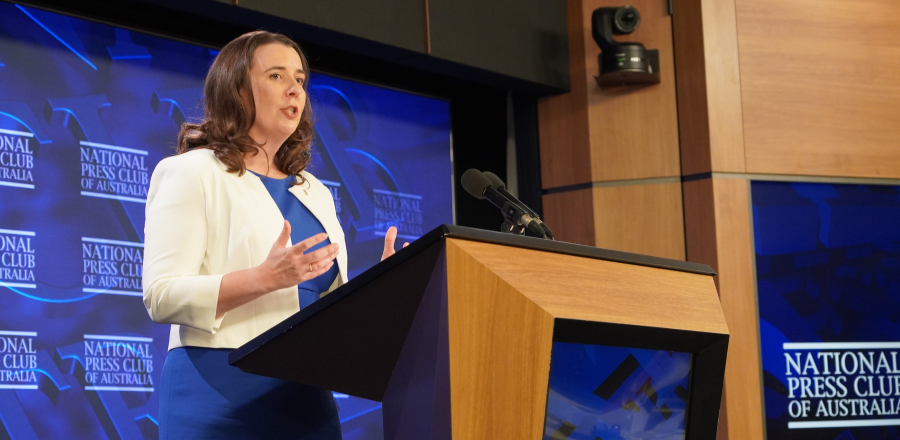
Transcript: AMA President, Dr Danielle McMullen, National Press Club of Australia address
Subject: Underpinning Australia's healthcare system — strengthening the base, not the facade
DR DANIELLE McMULLEN: Thank you, Tom, for that introduction. And thank you all for being here. Another welcome to our Samoan colleagues — I spent a few weeks there on my elective in medical school, in Apia, so a place close to my heart.
It really is wonderful to see so many of you here, to see so many people who agree that the best possible way to spend your Wednesday lunchbreak is talking about how to improve our healthcare system. I'd like to acknowledge that we're meeting today on the lands of the Ngunnawal people, and pay my respects to their elders past and present.
For generations, our Aboriginal and Torres Strait Islander patients, and colleagues, and friends have understood that health is about more than just the absence of disease. It's a complex interplay of physical, social, emotional and spiritual well-being. And just as we must always look after our own health, our health system also needs regular maintenance.
I'll open by saying that we have an excellent healthcare system. Our balance of public and private care, our strong primary care sector, our system sustainability overall, and most importantly our health outcomes, are the envy of most of the world. But, as our Press Club CEO Maurice said to me not long ago, if the AMA was ever entirely happy about our health system, we'd all be out of a job. And while we do have an excellent health system, it certainly is in need of some maintenance.
I'm here today to implore us to not let our system fall into disrepair, to highlight how we could make the most of some of our best health system aspects and not fall into the trap of a quick lick of paint. If our health system was a house, would we say it has good bones? Perhaps a few rooms that are in need of a bit of repair or renovation? Would it pass a building inspection? I expect there’d be a few caveats. Here in Canberra, long dry summers and your clay soils combine to lead to cracks in houses, and over time those cracks can become structural. And if not fixed properly, then what? We just patch it up with a bit of plaster, a quick coat of paint, and a she'll-be-right attitude. At what point does that house start to crumble? What about the cracks facing our health system? From my perspective, they're not small or insignificant or cosmetic. They're being felt by our patients every day, and by the doctors trying to hold our system together. The truth is that yes, we have a great health system, but every part of it is under strain. And parts of it are perhaps no longer structurally fit for the demands placed upon them. We mustn't fall into the trap of just that slap of plaster.
I'll start where most Australians begin their healthcare journey and where I spend most of my time, in general practice. It's the foundation of our health system, it's where issues are picked up early, where chronic and complex disease is managed, where continuity of care lives. And when it works well, general practice keeps people well and out of hospital. But general practice is being asked to do more and more, with a funding structure from another era. Australians are getting older, our population is ageing, and we're living with more chronic conditions. That means that the care that we're providing to everyday Australians is necessarily more complex, takes longer, and is more dependent on strong coordination. And yet, Medicare still largely rewards short consultations and penalises the time that it takes to provide that more comprehensive care.
Government's recent efforts to bring down the out-of-pocket costs for patients attending general practice have had some impact, but it's not the deep structural reform we need, particularly to support our most vulnerable. What we need is a new seven-tier Medicare item restructure that supports GPs to deliver not just the acute care, but also the chronic and complex care that we're trained and skilled to provide. We also need additional workforce supports to be able to get bigger teams into general practice and provide that wraparound care of a healthcare team working together.
Our nation has a primary care 10-year plan. It was thoroughly consulted on. It values general practice as the hub of strong coordinated teams, and it's future thinking and ready for the health challenges that our country will face. So it's time we back in that plan, and a bit more on that later. Because no matter how excellent our general practice system is, we will always need our public hospitals. People with severe and life-threatening illnesses or those needing surgeries will always need hospital beds. And yet, our hospitals remain in crisis. Ambulances are ramped, patients are waiting far too long for planned surgeries, and our emergency departments are overcrowded. Our staff are exhausted, burnt out and often facing abuse just for trying to do their jobs.
We hear a lot about efficiency in our health system, but that's like trying to ask me to squeeze more water out of a dry rag. There is no more efficiency to gain when we've got patients being treated in corridors, we've got people who should be discharged home but have nowhere safe to go, and when our staff shortages are at such a state that our rosters are being held together by goodwill. But the hospital logjam is not a hospital problem. It's a system-wide issue and reflects failures in aged care, disability support, community care and overall system planning. And it's costing patients time, and dignity, and sadly in cases, their lives.
It was a huge relief earlier this year to finally see the signing of a new National Health Reform Agreement, and we welcomed the Commonwealth's additional funding to help our public hospitals get back on track. It followed years of advocacy through our AMA Clear the Hospital Logjam campaign. But our costings show that it may not be enough. And regardless of the funding, we need real reforms to make sure that we can tackle the logjam and really have our public hospitals operating at their peak performance. Solving the pressures on our public hospitals will take genuine cooperation and coordination between levels of government, across disability, ageing and health. It's enough fighting about the money now. We need to all agree that actually we're all on the same page, we want the same outcome and patient care must come first.
But if all that doesn't sound stressful enough, imagine the pressure on our public system if we didn't have such a strong private healthcare sector here in Australia. Unfortunately, our private sector is also facing growing challenges. Minister for Health Mark Butler often talks about the sharp elbows in health stakeholder meetings. And there's certainly been some very sharp elbows pointed squarely at doctors over the past few months. Every day in my general practice, I see patients struggling with the costs of healthcare. They're delaying care, putting things off, and questioning which test or treatment they really need most. It is a real issue. But laying that blame squarely at the feet of just doctors is a convenient misdirection. It's a look away moment, away from the more difficult and complex issues facing the sector.
In case there's any doubt, let me be clear, the AMA does not support egregious billing. We've long promoted quality informed financial consent, and in fact led work with a group of other peak bodies around developing a toolkit and a guide for both doctors and patients around informed consent.
What hasn't entered the discussion enough recently are the other factors driving costs for patients. Medicare, which underpins our private sector, has failed to keep pace with inflation, wages cost, with other real-world costs that drive those gaps for patients. Public outpatient clinics are few and far between, feel impossible to find in some parts of our country, essentially forcing people into a private sector when they can't get a public appointment. And private health insurance medical benefits, paid back to patients, have also lagged despite rising premiums, meaning patients are paying more and getting less.
Interestingly, within just two weeks of a report shining the spotlight on doctors' fees, Australians were told that the average health insurance premium would increase by 4.41 per cent this year. The largest increase in nearly a decade. This premium increase is a significant blow to families already doing it tough in a challenging cost-of-living environment. We know many Australians have already downgraded their cover, and I fear many more will. Sixty-eight per cent of health insurance policies now contain exclusions. Another example of Australians getting less but paying more.
But this isn't just about money. I've also seen the real world, clinical impacts of these changes in the private sector. Patients don't know or understand the difference between a knee reconstruction and a knee replacement. Knee reconstructions live in silver, generally, and knee replacements in gold. And so I've had patients who weeks before a planned surgery have found out they have inadequate cover. Orthopaedic waitlists in many parts of this country are two or three years long, and that's just to get the appointment. That's not the surgical waitlist. So, in desperation, these patients in pain have sometimes turned to self-funding their entire surgical experience. That lets insurers off the hook. That's not fair.
The challenge facing governments and insurers is whether they're prepared to address the underlying costs facing patients, rather than just finger pointing at convenient scapegoats, because outrage at doctors may make for some great headlines for all of the media in the room, but it doesn't make a great recipe for sustainable reform.
The AMA will continue to push for a private health system authority, stakeholder-led, independent body to do the deliberate design that we need in our private health system and fit for purpose regulation to make sure that our private health sector is delivering high quality, value for money, care for Australians, that's well co-ordinated in our broader health ecosystem. With the challenges facing health at the moment, the need has never been greater for an independent body with ability to withstand those sharp elbows.
But of course, wouldn't it be great if we never even needed to set foot inside a doctor's surgery or a hospital. Unfortunately, we're heading in the other direction. In 2024, smoking was overtaken by overweight and obesity as the largest course of preventable disease in Australia. And yet, we continue to treat prevention as optional, as a nice-to-have that we can do when the budget allows. The government could introduce an evidence-backed policy that both makes an impact and boosts Treasury's coffers, a tax on sugar sweetened beverages. Backed by the World Health Organization, it's a win for patients, a win for health, and a win for Treasury. Everybody gets a win.
Even our House of Representatives Committee on Health, Aged Care and Sport recommended a sugar tax in 2024. And yet, the advice of experts keeps being ignored. Maybe it's the word tax that has governments shying away from this policy, particularly at the moment. So I don't care, call it what you will, but we just can't keep kicking this can with 12 teaspoons of sugar in it further down the road.
So, we've just taken a tour of the house, had a look at a few of the rooms that might need a bit of repair, but what about some recent renovation attempts? We've seen some new additions spring up in our health system that just don't quite seem to fit. New doors that aren't really connected to the rest of the house.
Since early 2024, state governments have been introducing NHS-style pharmacy prescribing. In fact, much broader than the NHS rules in some states. It's quick, cheap, punter-friendly maybe, although if you scratch the surface of some of the consumer data, it shows that actually consumers want tight guard rails around this prescribing and not just open-ended scope expansion. Is it successful? Who knows. We're yet to see any quality evidence that it's working to improve outcomes or access, but we are concerned that it doesn't line up with our primary care 10-year plan.
Is it dangerous? Again, who knows. Mechanisms to report adverse events or near misses are absent or hard to find. Of course, errors happen in healthcare. I make mistakes too. I've had phone calls from the local pharmacy questioning a dose on my prescription, and sometimes there has been a mistake. I value those phone calls. It's a really important safety step, and it's a good example of team-based care. What I don't agree with is system-wide change that increases risk and reduces double-checking, or changes that ask clinicians to make new and bigger decisions without adequate information available to them or the training to make those decisions.
Now, before cries of patch protection ring out, that's not what keeps doctors awake at night. It's the many new doors opening up that fragment our health system, and pharmacy prescribing is only one of them. Another is urgent care clinics. A seemingly well-meaning policy that still needs a fair bit of work. I'm glad they're GP-led, but they do need much more integration into our health system given that still, one in three of the interactions at an urgent care centre doesn't have any communication back to the usual GP.
And despite the introduction of urgent care clinics, I've just told you our hospitals are still in logjam, so are they working? The real solutions lie in our network of more than 7000 general practices spread right across the country in our most rural and remote regions. With the right supports, I'm confident that general practices can deliver both the acute care alongside chronic care that Australians really need.
We're seeking solutions that make it sustainable for general practices to open for longer hours. Changes as simple as recognising that staff costs and after-hours happen before 8pm. We seek solutions that modernise Medicare rebates so doctors can properly spend the time they need with patients, and we're also encouraging government to provide more funding to nurses, pharmacists, allied health, to work inside our practices and under one roof. That would improve access to care.
I'm sure that my patients would value the opportunity to come and see me or to see our pharmacists and talk about their medicines, or spend some time with a diabetes educator, with the confidence that their team was genuinely all talking to each other.
At the moment, the many front doors being opened up are not helpful when they're not connected to a GP. It seems at the moment that access is the only goal in health policy, but to show the risks of access above all else, I'll share a story about a patient of mine — with permission, although I won't use her real name. It's a story that should sound alarm for policy-makers and decision-makers alike.
Jane is in her mid-50s. She works part-time, she looks after her elderly mother, and she has a bit of asthma but otherwise she's fairly healthy. She was getting more short of breath, and so she went to the local urgent care centre where she was told it's probably her asthma, increase your use of your puffer. A week or so later, she wasn't getting any better so she went to a satellite hospital, which is another hospital avoidance strategy we have up in Queensland, and she was told much the same. Again, a week or two later, she really thought maybe she was getting worse and phoned an urgent care centre and was given advice to self-treat at home and go and see them in a few days' time. She came to see me instead.
I hadn't met Jane before but she'd been coming to our practice since we opened. And so I had a collation of reports faxed to our clinic. I could scour her My Health Record and get some more health information there. So I had a bit of a picture. Although, by that stage, it didn't matter much. She looked awful. She could barely breathe; her oxygen levels were low.
I listened to her chest and it certainly wasn't asthma. It was something I hadn't heard in about 10 years. But thanks to my broad clinical training, I knew what I was hearing or rather what I wasn't hearing. I couldn't hear any air moving in and out of her left lung. So I phoned around and I managed to get her a same day CT scan and an x-ray. And unfortunately, that showed what I suspected. This wasn't asthma at all. Jane had widespread cancer, and her left lung space was filled with cancerous fluid.
Telling someone that they have a severe and life limiting illness is awful, but it is also an enormous privilege. My role as a GP is to walk with people through the darkest moments of their life and help them navigate the system and find their way through it.
Thankfully, against all odds, Jane is actually doing remarkably well. But she was keen for me to share her story as an example of the gaps in our health system, how patients can fall through them and the power of having a usual GP. Because Jane did nothing wrong. She got sick, she sought healthcare. She wasn't getting better, she sought more care. But what she couldn't know and what she didn't know was that the doors she was opening weren't connected in the back, so no one got the full story. No one got that moment of: hang on, this lady's been in a couple of times. What am I missing? What's really going on here?
A system that's designed for acute minor illness didn't pick up something more serious. And that's what we're talking about with continuity of care. That is the value of continuity. I'm not magic. I'm not going to pick something up always on the first time either. But by seeing someone for both the small things and the big things, by attending the same clinic, even if it's a different doctor a few times in a row, we're trained to put those pieces of the puzzle together and make sure we get there as quickly as possible.
Jane's story demonstrates how this approach that there's so many front doors and no wrong door, while it's a well-meaning policy direction, can be confusing and at times can be dangerous. So, when we renovate let's make sure that it's in line with the home design that we actually want to see, not a lick of paint and not an ugly addition that doesn't quite connect.
Today, I'm releasing our 2026‒27 Pre-Budget Submission. It's not a wish list, it's a set of practical, costed, evidence-backed policies that recognise a simple truth. If we want a health system that works for patients, we must fund it to work. We must Modernise Medicare with a new seven-tier item structure. We must invest in connected multidisciplinary care. We must fund after hours in general practice so that emergency departments aren't the default option. We must actually reform our public hospital funding to clear the logjam and get patients the care they need. We must reform private health insurance to make sure it's delivering value for money and transparency for Australians. We must take prevention seriously and implement a tax on sugar-sweetened beverages. We must value continuity of care.
And to do all of that, we must build a workforce that's sustainable and ready for the future. A collaborative and coordinated workforce that's genuinely working together. Where yes, we maximise everyone's skills, but we do it together. We must think very carefully about changes to scope of practice. It may not be the governments of today who bear the ramifications of ill-thought-out policies. It's our patients who face the highest cost. Australians rightly expect a health system that's there when they need it. And doctors expect a health system where they can work safely to deliver high-quality care to Australians.
Right now, too often, neither of those is being met. But if we act now, we can undertake the renovations and repairs that our health system needs. But act now, we must. Thank you.
Dr McMullen’s initial address ends