Blame games distract from what’s really impacting costs for patients
The following quotes can be attributed to Dr Michael Lumsden-Steel - AMA Tasmania President
“Doctors are increasingly frustrated at being blamed for a problem created by years of inadequate Medicare funding. The reality is the rebate no longer reflects the true cost of providing care, which is why patients are seeing a gap.
"Private specialists, like GPs, operate small businesses with staff, equipment and overheads to cover while also providing highly skilled medical care. They are not government employees, and it is not the role of government to dictate fees while failing to fund the system properly.
"If the government is serious about improving affordability for patients, the solution is clear: Medicare rebates must be lifted to reflect the real cost of care. A good place to start is to match rebates to the AMA Fees List."
The continuing blame game about specialist fees is ignoring the realities of what’s driving cost for patients, the Australian Medical Association said today.
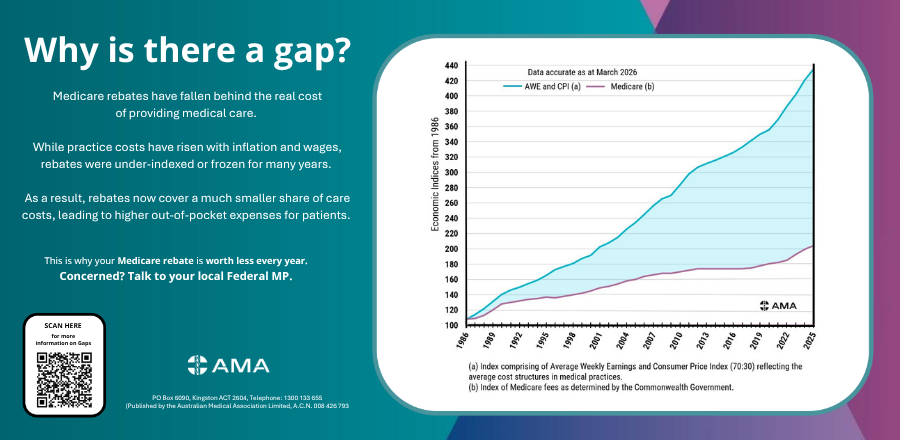
The AMA has released a new Gaps Poster showing once again how far behind the Medicare rebate has fallen, compared to costs of healthcare.
Australian Medical Association President Dr Danielle McMullen said as inflation and costs soar — for both patients and medical practices — the Medicare indexation rate remains stubbornly low.
“We have had decades of under-indexation, and half a decade of a Medicare freeze, leaving the rebate woefully out of reach of covering the cost of care,” Dr McMullen said.
“While recent government injections into Medicare bulk billing incentives are positive and have improved access to care, these relate to a tiny fraction of the more than 5,000 MBS items.
“These are ‘bolt-on’ incentives, not Medicare reform. And they don’t do anything if you need to see a specialist for a consultation, a privately billing GP, or need surgery.
“The continuing attacks on doctors are neither helpful nor focused on the kinds of significant reforms that would make a difference.”
Dr McMullen said only the underlying Medicare rebate applied to all medical services, and it continued to be left to stagnate, while costs inflate.
“To help people understand why gaps exist in their care, and to guide governments on how to address them, our Gaps poster includes a QR link to our resource which outlines the policy gaps that currently lead to patient gaps. It outlines the clear steps governments could take right now to help patients and practitioners.”
The AMA is continuing to call on the government Modernise Medicare in general practice, by increasing GP rebates under a new 7 tier item structure, which will ensure we have a fit for purpose Medicare, ready to tackle complex, chronic disease.
In non-GP specialist care the AMA is calling for injections into Medicare rebates, reform to the no-gap policy under private health insurance, an increase in the known gap rate, better indexation and transparency of varying insurer rebates, and a greater return of patients’ premiums back to their healthcare.”
“We must also see real investment in public hospital outpatient clinics so that patients have access to both public and private options for care.”
Dr McMullen said that in the health minister’s recent National Press Club he had lamented the fact that the first term of government didn’t leave time to fundamentally reform Medicare.
“Now, when cost of living is really biting is the time to act. Without action the gaps will only continue to grow, further impacting patients.”